Everyone lists the rentals. We built a brand that makes many feel like one.
Renting from a stranger is an act of trust, and GetMyRentals is built from many strangers: independent rental businesses across Kerala. Zeekoi built the identity so that all of them feel like one name you already know.
GetMyRentals doesn’t own the cars. Kerala’s rental businesses do. So the brand had to be the one thing that stays the same while the owner behind every booking changes, and the answer was already sitting in its own name.
The short versionClient
GetMyRentals, a Kerala marketplace for cars and bikes, run on a network of independent rental partners.
The challenge, as we read it
Make a business built from many other businesses feel like one you can trust.
What we built
An identity, a pattern system, a voice, and applications from a car door to an app screen.
Brand book
Edition 2026. Typefaces Sora and Lexend. Four colours, sixteen glyphs.
01 / The moment before you book
Before you book, you quietly ask four questions.
Kerala had a record year for visitors in 2025, and some of them will want a car or a scooter for the week. They will do what everyone does: find a listing, look at the photo, and wonder whether they can trust it.
tourist visits to Kerala in 2025, the highest on record
more domestic visits than in 2024 (25.06M against 22.25M)
The only vehicles legally rentable for self-drive wear black plates with yellow lettering.
What will this really cost me?
Kilometres, cleaning, tolls. Public reviews keep circling the charges that appear after pickup.
Will I get my deposit back?
Refund disputes are another theme that keeps coming up on public review pages.
Is this operator even legitimate?
Kerala press warns about unauthorised rentals, and fake operators borrow trust-marks to look real.
Will the car actually be there?
The old marketplace letdown: listed, but not really free. We found nothing that measures it in Kerala, so this one is our reading.
Themes from Kerala press and public review pages. Directional, not measured.
A marketplace makes it harder. The car on your screen belongs to someone else.
02 / The strange part
GetMyRentals runs no fleet. It still has to be the name you trust.
Rental businesses keep running their own fleets on Rental OS. GetMyRentals brings them the customers, takes the booking and keeps the promise. That is an unusual thing to build a brand around: people are asked to trust one name for something other people hand over.
Rental businesses
Vehicles, staff, handover and return.
Rental OS
Each partner’s fleet, availability and bookings.
API and sync
Live availability, holds and booking push.
GetMyRentals
Catalogue, pricing, KM packages and the Right Choice.
Customer
Search, choose and reserve.
The brief, as we read it
The customer should meet one brand.
One brand, one catalogue, one price. The partner who fulfils the rental stays in the background until the booking is reserved. So the identity couldn’t be a badge you stick on a car. It had to be the thing that stays the same while everything behind it changes.
Not a directory of rental companies. One rental platform.
GetMyRentals positioning, from the brand book
Every partner lists its fleet its own way.
Most brand work starts from what a company is. Here the more useful question was what stays constant when the fleet, the owner and the pickup point all change. Everything that follows is an answer to that.
03 / The idea
One box in the logo became the whole pattern.
The pattern isn’t decoration laid on top of the logo. It is the logo, repeated, which is how a network of many ends up reading as one.
Start with the name.
get my rentals. Three plain words, and one of them sits in an amber box.
Look at the box.The box is where it becomes yours.
‘my’ is the only word that is about you. The check breaks out of its box: the right rental, confirmed. The brand book calls that check the heart of the brand.
So we kept the box.Its corners are exact.
A corner radius of 16.5 on a 134.4 square, which is 12.3%. Not a style choice. A number the rest of the system can borrow.
Everything else will.Now let it hold something.
Same corners, same proportions, but this box holds one thing people rent. The book calls each tile one listing in the catalogue.
Then let it multiply.
Cars, scooters, cameras, calendars. Whoever owns the vehicle behind the booking, the customer sees the same box in the same grid.
Many in. One out.A pattern borrowed from a logo only works if the borrowing is exact. We checked the arithmetic: 16.5 ÷ 134.4 is 12.28%, and the book builds every tile in the 96-tile master repeat on that same ratio.
04 / What goes inside the box
Sixteen small drawings, each there for a reason.
Most rental sites are a wall of near-identical cards. Here the tiles do some of the talking. Cars and scooters are the business today. Cameras, laptops and phones are where the book says it could go next. The sun, the palm and the backwaters remind you the rental is for a trip, and dates, a pickup point and the handover are the booking itself. Tap a drawing or a tile type to find it in the 96-tile master repeat.
Vehicles · what we rent today and next
Gadgets · categories still to come
Kerala journeys · where people take their rentals
The booking · how GetMyRentals works
Or highlight by tile type
The master repeat
12 × 8 tiles. It repeats seamlessly in every direction, so a wall, a car door or a lanyard can all be cut from it.
Four families, not sixteen random icons: what you rent, what you might rent, where you take it, and how you book. Because the families are fixed, a new category can slot in without anyone redrawing the system.
05 / Why it won’t fall apart
A system is tested on the day someone else uses it.
Logos get looked after by their designers. Patterns get used by partners, printers and people on a deadline. So the book turns taste into numbers, all taken from the logo. Tap through the four measurements to see what each one controls.
Five rules · from the book. The ‘protects’ lines are our reading.
- Never touchingThe same glyph never touches itself, and repeats sit at least three tiles apart.A wall that never looks copy-pasted.
- Accents apartGo Amber tiles, Soft Ivory tiles and amber glyphs never touch their own kind.Amber staying rare enough to still mean ‘go’.
- Mixed familiesSide-by-side tiles come from different glyph families.A car sitting next to a sunset, not another car.
- Fixed pairsGlyph colours follow the five tile types. Nothing rotates or resizes.Nobody improvising their way off-brand.
- Use the masterBuild layouts from the 12 × 8 master repeat, not by hand.The hard layout questions, already answered.
06 / Colour with a job
Four colours, four jobs. Amber has the hardest one: staying rare.
Tap a panel to open it. The blues carry the brand and the ivory keeps it warm. Amber is rationed on purpose, because a colour that means ‘go’ stops meaning it when it is everywhere.
Trust Navy
Deep and steady, for trust, reliability and stability. It carries the logo and the main surfaces, the weight of the brand.
RGB 2, 31, 45
CMYK 96, 31, 0, 82
Horizon Blue
Discovery and optimism: the colour of finding the right rental. It does most of the pattern’s work, which is why the wall feels open rather than corporate.
RGB 21, 74, 107
CMYK 96, 70, 36, 21
Go Amber
Action and momentum. It marks the button you press and the tile that confirms a booking, and it is rationed so it still means something.
RGB 255, 187, 34
CMYK 0, 25, 95, 0
Soft Ivory
Comfort and a human touch. A warm ground that keeps a product built on live availability from feeling like a system.
RGB 255, 253, 243
CMYK 0, 0, 4, 0
Blues carry 55% of the pattern. Accents stay at 45%. In the app, amber goes to the Search button and to the Handover tile that marks a confirmed booking.
07 / Voice
It sounds like a good host. Not a booking engine.
Trust is mostly built in small sentences: the price line, the confirmation, the pickup message. The book gives four rules, each with a line to say and a line to avoid.
Plain words, real numbers, one price.
160 km a day, one price for 4 days.
Prices starting from…
Our reading. A number can be checked. ‘Starting from’ can’t.
Only say what we know is true.
Available for your dates.
Hurry, only 2 left!
Our reading. No manufactured urgency. If it isn’t known to be true, it isn’t said.
Name the places people actually go.
Pickup in Edappally at 10:00 AM.
Pickup at your nearest hub.
Our reading. A named place and a time is a promise someone can turn up to.
Speak like a good host.
Your car is ready.
Booking request processed.
Our reading. The same fact, said the way a person would say it.
Say and avoid lines are from the brand book. The notes marked ‘our reading’ are ours.
08 / Promises
The four worries from the start, each with an answer.
The brand book lists six principles. These four are the ones that answer what customers and Kerala press actually describe. The pairing is our reading, so every row carries its own confidence.
What will this really cost me?
Public reviews and consumer guides keep returning to charges added after pickup: kilometres, cleaning, tolls.
DirectionalOne clear price
GetMyRentals sets the price and the KM packages, the same way across every partner. The book’s promise is a price that holds.
From the brand bookWill I get my deposit back?
Refund disputes are a recurring theme on public review pages for Kerala-based rental firms.
DirectionalReserve with 20%
A 20% advance reserves the vehicle. It is part of the rental, not a fee on top.
From the brand bookIs this operator even legitimate?
Kerala press (August 2026) warns of unauthorised rentals. Only vehicles under the Rent a Cab scheme may be rented for self-drive.
MediumOne brand over a network
Customers book with GetMyRentals, not with a stranger. Partners run their fleets on Rental OS, and their details are shared once the booking is reserved.
From the brand bookWill the car actually be there?
The classic marketplace letdown: listed, but not really free. We found no source that measures it in Kerala.
Our readingLive, not listed
Customers only see vehicles that are really available, straight from each partner’s Rental OS, and every booking is pushed back so nothing is booked twice.
From the brand book09 / Where it meets people
A car door, a key tag, a phone: where trust gets tested.
The pattern breaks into single tiles in the product, so the catalogue you browse looks like the brand on the car. Try the app screen: press Search.


Where to next?
Reserved
Your Trust. Our Promise.


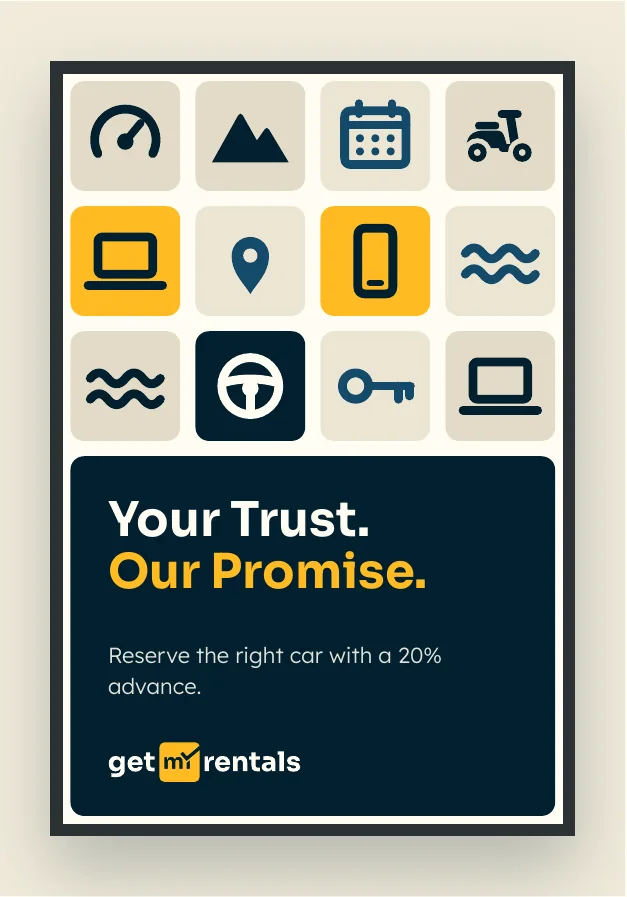


The car at pickup
The first place the promise gets checked: a partner’s car wearing one name, one logo, one pattern.
The key tag at handover
One amber tile holding a car. The last step of the booking, made physical.
The app screen
The glyphs double as category icons, and the amber Handover tile marks a confirmed booking.
Social posts
The tile wall travels as a header, so a post can be recognised before its headline is read.
Application visuals are mockups from the GetMyRentals brand book. They are concepts, not live deployments. The notes above are our reading.
10 / How we would know
We would rather show you how we’d know than claim we do.
We found no public launch results for GetMyRentals, so we are not claiming any. Here is what we would track to see whether one brand is forming out of many.
Search to reserve
Of the people who run a search, how many go on to reserve? The identity and the one-price promise should show up here first.
Booking funnel, before vs after launchPrice and charge questions
Support contacts about charges, deposits or the advance, per 100 bookings. If ‘one clear price’ is working, this falls.
Support tags, monthlyBrand recall
Branded search and direct visits over time. A network only feels like one brand if people start asking for it by name.
Search console, analyticsRepeat booking
Share of customers who book a second time, and whether they come back to GetMyRentals or to the partner.
Booking data, quarterlyProposed measures. Nothing here is a reported result.
11 / Questions
Questions worth asking.
Straight answers about the thinking behind the identity. Brand facts come from the client’s own book, and the market facts from published reports.
Why does a marketplace need its own pattern?
Because a marketplace is where a customer meets many businesses at once. Every partner lists its fleet its own way, and GetMyRentals maps them all into one standard catalogue. The pattern shows exactly that on the surface: each tile is one listing, in one shape, on one grid. The customer sees one catalogue, whoever owns the vehicle.
Why is the pattern built from the logo’s box?
So the two can never drift apart. The ‘my’ box in the logo has a corner radius of 16.5 on a 134.4 square, which is 12.3%. Every tile uses that same ratio, so the pattern is the logo repeated, not a second visual idea sitting beside it. That is what lets many businesses read as one brand.
What happens when GetMyRentals adds new categories?
The system already has room for them. The library holds sixteen glyphs in four families: vehicles, gadgets, Kerala journeys and the steps of the booking. Cameras, laptops, phones and headphones stand ready for the categories still to come, and every new glyph is drawn to the same rules: a drawing area of 0.6 of the tile and a line weight of 0.08 of the tile, with round ends and joins.
How do you stop the pattern being misused?
By turning taste into rules. The same glyph never touches itself, and repeats sit at least three tiles apart. Amber and ivory tiles never touch their own kind. Side-by-side tiles come from different families, glyph colours follow five fixed tile types, and layouts are cut from a 12 × 8 master repeat of 96 tiles instead of being built by hand. Below 24 px or 6 mm, the glyphs drop away and plain tiles take over.
Why four colours, and why is amber so scarce?
Each colour has one job. Trust Navy carries the logo and the main surfaces, Horizon Blue stands for discovery, and Soft Ivory keeps the brand warm. Go Amber marks action: the Search button and the tile that confirms a booking. The blues make up 55% of the pattern and the accents 45%, and amber is held back so that it still means go.
How should GetMyRentals sound?
Like a good host, not a booking engine. Four rules: be clear (plain words, real numbers, one price), be reliable (only say what we know is true), be local (name the places people actually go) and be warm. So ‘Pickup in Edappally at 10:00 AM’, never ‘Pickup at your nearest hub’, and ‘Your car is ready’, never ‘Booking request processed’.
Where does the brand show up beyond the app?
At the moments where trust gets tested. The brand book carries it onto vehicle livery, a handover key tag, ID cards, business cards, posters, social posts and the website, so the customer meets the same name at pickup as on the screen. These are concept mockups, so none of it is presented as live.
What was happening in Kerala that made trust the central job?
Kerala logged a record 25,880,365 tourist visits in 2025. At the same time, Kerala press has been warning travellers about unauthorised rentals: only vehicles under the Rent a Cab scheme, with black plates and yellow lettering, may be rented for self-drive, and fake operators have used association names to look legitimate. Public reviews also keep returning to surprise charges and deposits, which we read for themes rather than for how common they are.
Press-reported, medium confidenceWhat results has the identity delivered?
We found no public GetMyRentals launch data, so this page claims no results. What it shows is the system itself, checked against the brand book. Once it is live, we would track four things: how many searches become reservations, how many questions come in about price and charges per 100 bookings, branded search and direct visits, and how many customers book a second time.
Could the same approach work for a business like ours?
If you run a platform, a group or a marketplace, yes, because the starting point is the same: find what every part already shares, then build the system out of it. Talk to us and we will start there.